Dolls Nest
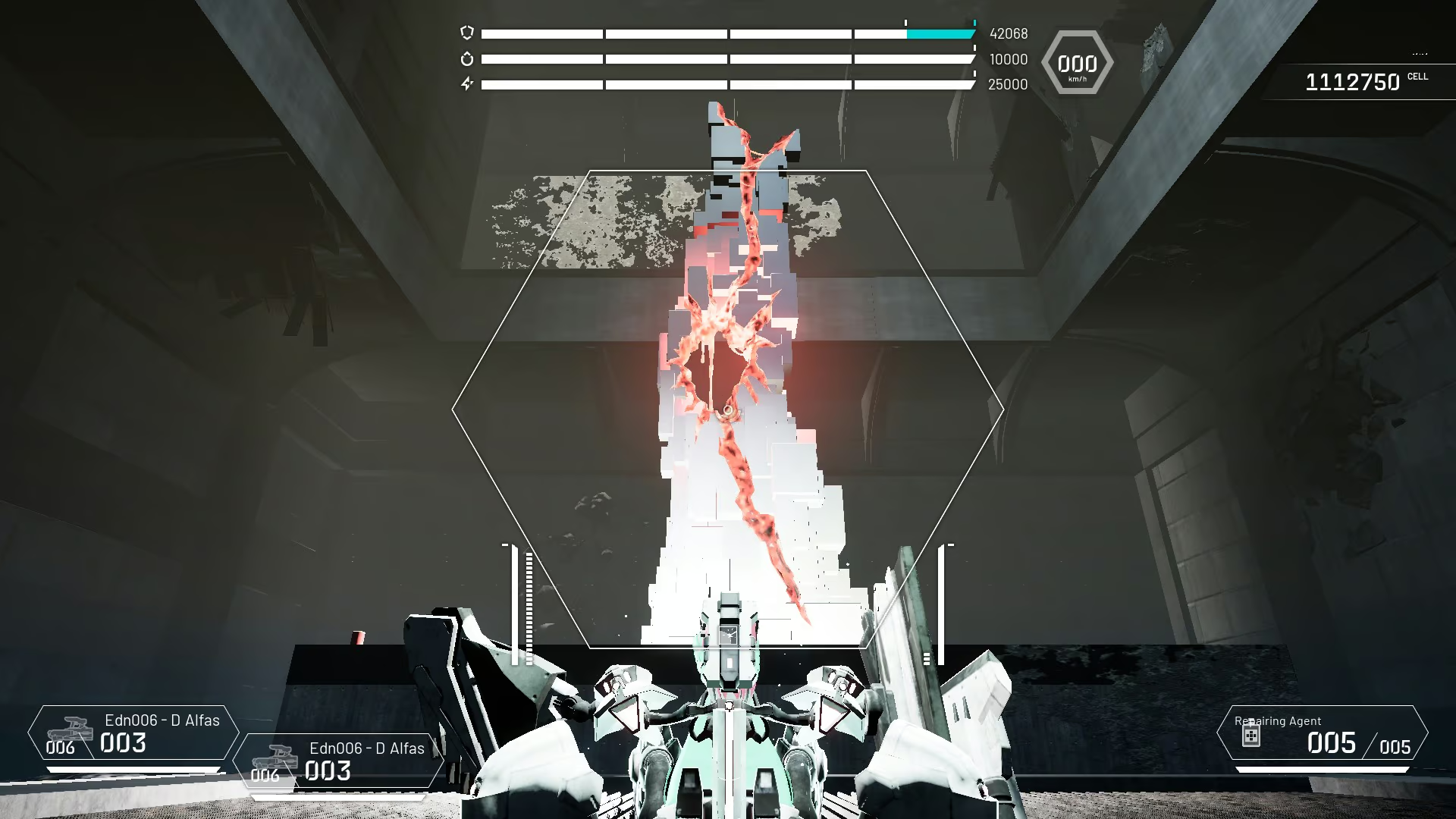
When I was just a wee lad, just twelve years old, I read the online creepypasta "Squidward's Suicide". As an adult, the whole concept is laughable to me but as an impressionable twelve year old I was very deeply affected by this, and it really stuck in my mind for a few days. I remember the day very clearly; my sister was away at my grandparents, and my mother had made me and herself some bacon sandwiches for a late breakfast. But still the images described within circulated around my head, and I decided I needed something else to distract myself. I had recently downloaded Portal 2, so I decided: let's play Portal 2!
I was not any good at Portal 2 at that age. I was really good at clipping through the levels
with sv_cheats 1 but the puzzles eluded me. So I would simply clip through the main
puzzle levels until I got to my favourite segment: exploring Aperture Science's maintenance
areas. These were definitely much easier areas of the game so I had little trouble just walking
through them and solving the puzzles with ease, but that's not really why I loved it. It was
seeing how it all ticked behind the scenes, walking through a gigantic facility—so
big that you can't even see the floor, so big that it has its own weather.
Eventually, I got to the old Aperture section, which I again no-clipped through because the puzzles were all too hard for my childhood brain. But there was one specific moment here that has stuck in my brain forever; right at the end, you climb back up to the last elevator shaft to the modern Aperture Science Centre, and you can look out towards a truly immense number of springs holding the entire modern facility upwards, fading out into the distance. It made my mind race with all these possible thoughts and ideas—just how big is this facility? How far does this go? I have always wanted something to recreate that feeling I had then, but I could never quite find it (not that I looked especially hard, though...). Then, I discovered Dolls Nest.
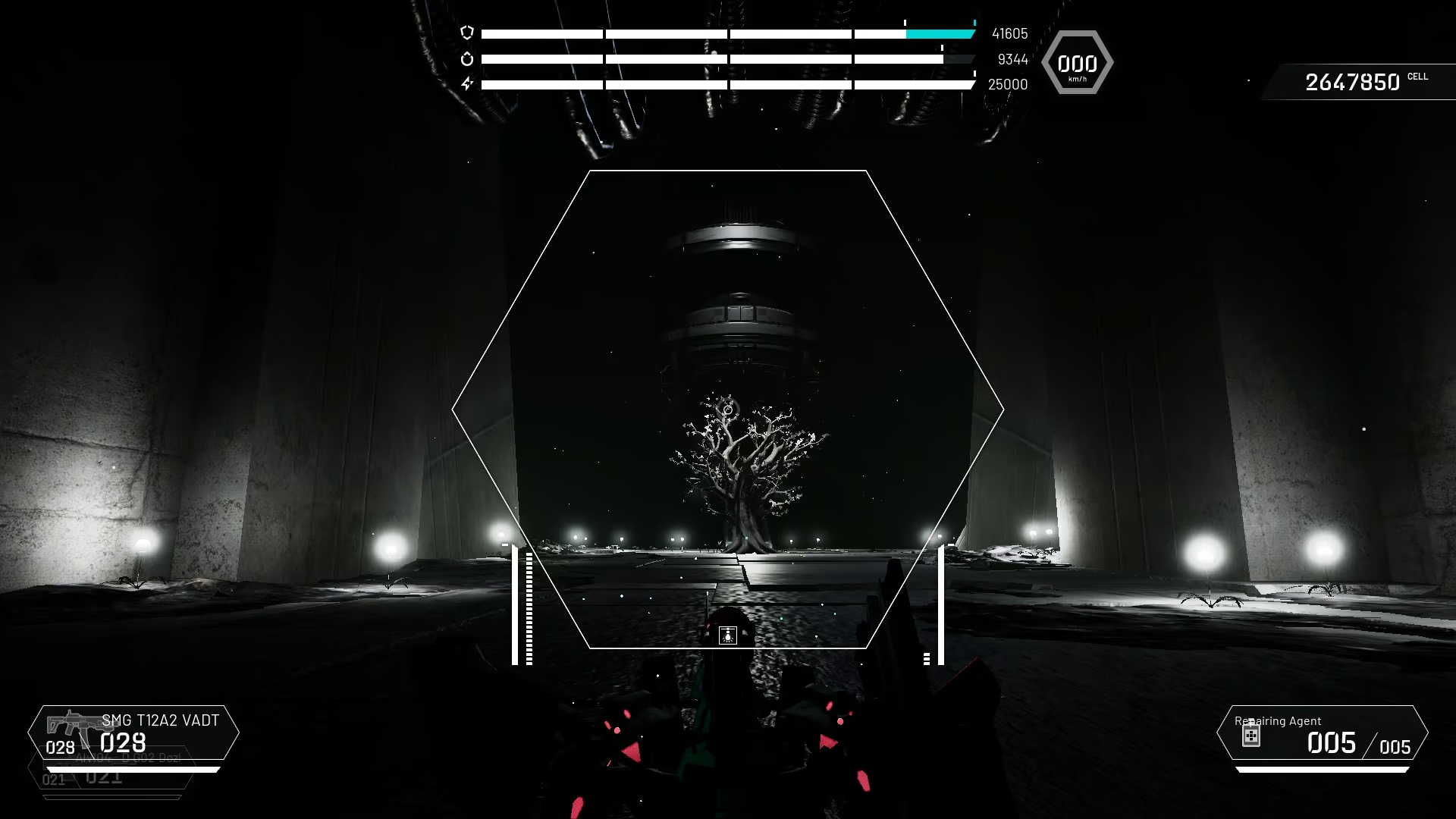
Dolls Nest is a third-person megastructure exploration mecha shooter. "Mecha shooter" is a bit of an odd genre in that you'd expect it to be a lot more popular given the popularity of mecha and giant robots in general, but is essentially dominated by two franchises: MechWarrior, and Armored Core, with Dolls Nest allegedly being closer to Armored Core than anything else. I've never played an Armored Core game except for five minutes of AC3 before the emulator dropped down to 20fps, so I don't know if these comparisons are true or not. Likewise, I've seen some people compare this game to the Dark Souls games—or, specifically, Demon's Souls—but I have never played one of those games either so I still have no possible comparison point.
The megastructure in Dolls Nest is "Hod", a gigantic city-like structure dropped within a gigantic crater. There's four layers of Hod, each being made up of three stages that connect linearly to each-other, although each layer is separate and only accessible via a teleporter tree in a subarea called the Broodchamber. The stages are sprawling mazes of catwalks, pipes, structures, tunnels, and corridors, with even more megastructures visible in the absurdly massive skyboxes you can find everywhere. Most of the architecture is decaying and broken; debris is littered all over the place, the walls are quite literally crumbling down, and the floors have ripped apart to expose the pipework and rebar within. Despite this, there's still a lot of light in most of the stages from artificial lighting, lots of tall structures for mobs to stand on, and functional elevators dotted all around the place.
Whilst most of the levels look roughly the same, there is some difference in the design. The upper-level stages (Upturned Forest, The Fault, Water Treatment Levels) are noticeably less ruined and have a blue-ish colour palette. The middle-level stages are decaying and crumbled, and have a neutral colour palette, but the architecture is very human-like with decaying residential buildings, motorways, and even multiple broken plazas. The lower-level stages (Accumulation Zone, Forbidden Domain, Tomb of Divine Knowledge) are the only ones with a continuous floor, being very desert-like and having lots of yellow and orange colours in the design. Finally, the deep level stages (Central Cavern, Depths, The Ark) are very grey and brutalist in design, clearly being the maintenance sectors of Hod.
Whilst these levels do look absolutely stunning to walk through, there is a big massive problem in that they are a total bastard to navigate through. Every area looks the same as every other area in a given stage and there are a LOT of extra paths to extra areas making it easy to get very lost very quickly. In some stages I found myself walking back and forth in one area trying to figure out where the hell the path to the next subarea is, because it all looks the same and there's no easy way to differentiate it. Some areas are far worse for this than others; the Water Treatment Levels takes place in mostly a gigantic flat area on the water and there's no less than three possible paths to take in any given direction (and two of them are wrong). The Arboreal Nest has a central area with multiple doors that lead to the next area, so if you take a break whilst in the central area you'll probably forget which way you wanted to go.
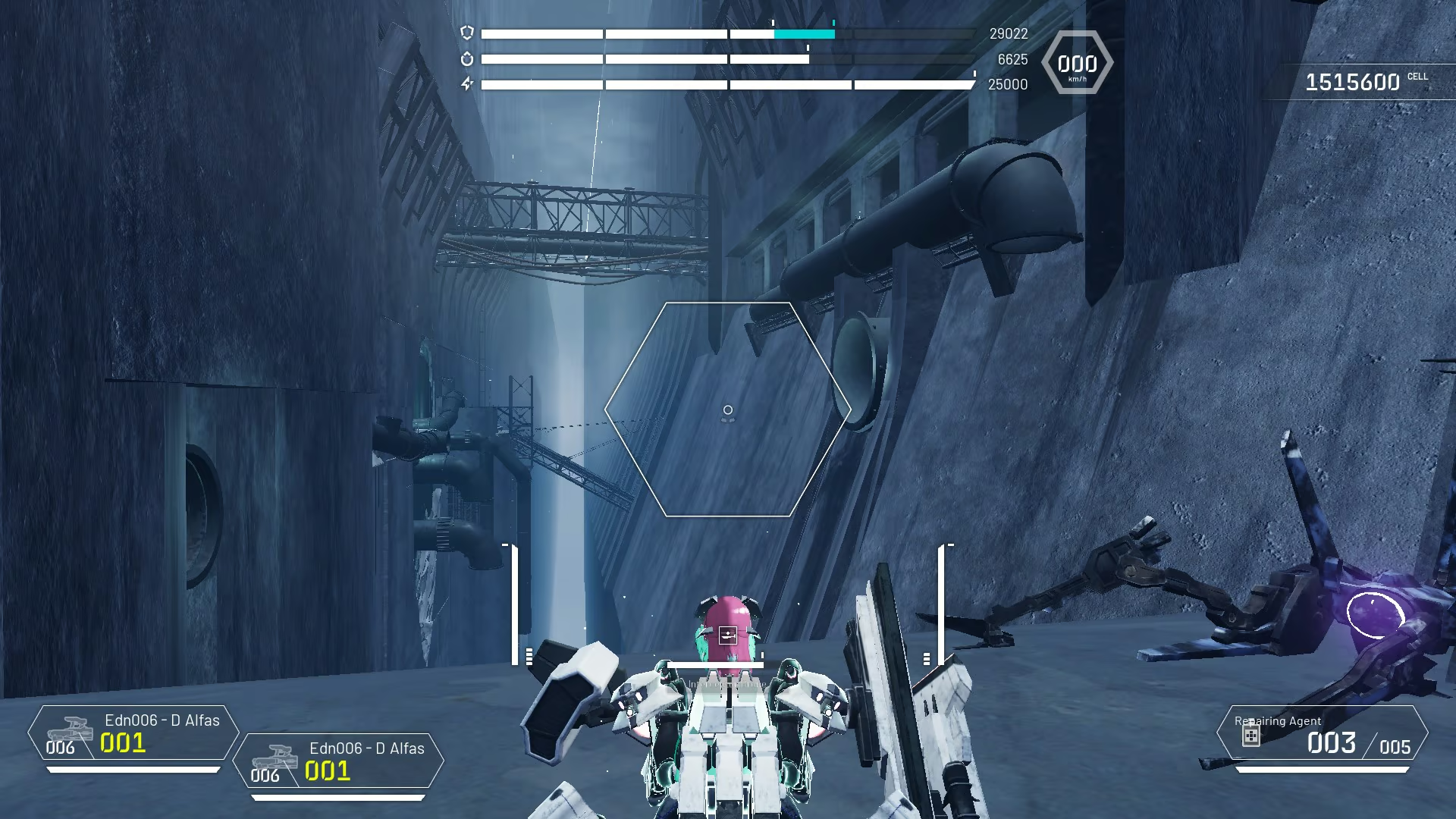
Additionally, despite taking place in the megapolis a lot of the areas are in inside areas, within long empty corridors or large blocky rooms with not much going on. The upper levels are the worst for this; The Fault starts you off looking at a gigantic wall across a valley that stretches from left to right all the way to the horizon. There's pipework criss-crossing between your side and that side that you can climb all over, or even go inside. Then you play the level and it's 90% inside corridors instead. Or, again, the Water Treatment Levels has a section with a truly gigantic ramp leading to the boss room; at maximum speed it easily takes several minutes to climb up there whilst fighting off the mobs—and once you've done that, you still need to zoom through several massive and empty corridors to get to the boss room. It feels like wasted potential. The worst is the poison swamp level, where the entire mandatory part of the level takes place on... one wall. You can go into the poison swamp, but it sucks and the loot sucks so there's not really much point. Instead you just zoom across the wall until you reach the boss arena.
The small saving grace is that every level is chock-full of shortcuts back to the start. Some are through one-sided doors which make every level into a loop through a subarea, whilst some are just fairy-ring teleporters that only work once you've activated the far end, but there's usually three to four dotted around every level. These shortcuts informally subdivide each level into segments, although there a few very poorly designed ones like the fairy ring in the Depth that has two enemies spawn-camping right next to the far end.
Whilst the actual aesthetics and atmosphere of the levels are great, the visual implementation leaves a bit to be desired. The sickly green colour palette and fog on the Accumulation Zone makes it the ugliest level by far, and the middle-level stages all have this PS3-esque yellowing over them. The lighting system is mostly fine, although point lights are all far too bright and some particle effects are like DX7-level overly bright such as the flamethrower particles. Unfortunately the lighting completely breaks in one specific level—The Depths— which is a full-dark area that you have to manually illuminate with either consumable light items or a drone utility frame and both of them do absolutely fuck-all against the darkness. The best strategy is to ignore killing any enemy that doesn't shoot you, because they will all light up the area for you.
I think I would care less about this if the game ran better. I do get that my computer is ancient by now, I'm still running a 1050 Ti which was weak at release, but a game with the general visual fidelity similar to Portal 2 should run better than it does. The worst performance drops came from any of the particle effects, which would legitimately drop the game down to around five fps if I got too close, which made fighting a certain boss extra fun because it had a special lag laser designed to ruin my day. It is, unfortunately, an Unreal Engine 4 game so I can't really expect much; running at low settings across the board does get me a good fps but fps counters make me neurotic so I can't put an exact number.
Even if the pure visuals of the levels leaves something to be desired, the aesthetic is made much stronger by the sound design of the game. The first thing I noticed is that the levels have no music, none at all. The only music is for bosses, the title screen, and the hub area; everywhere else there is nothing but environmental sounds. At first, I didn't really like this and felt like the game was missing a piece because of it, and I'm still torn on if a good soundtrack (say, some ambient DnB) would improve the game; but after playing it again I thought that the sheer atmosphere created from the ambient effects really works. There's the low hum of wind outside, the humming of machinery in the distance; you can hear the mobs stomping around and their mechanical systems, or your own frame making all the noises. You can hear the wind-up and wind-down of every enemy. It's like playing a competitive shooter where you stop and listen closely around you to figure out where things are, where they're going, how to avoid them (or run into them).
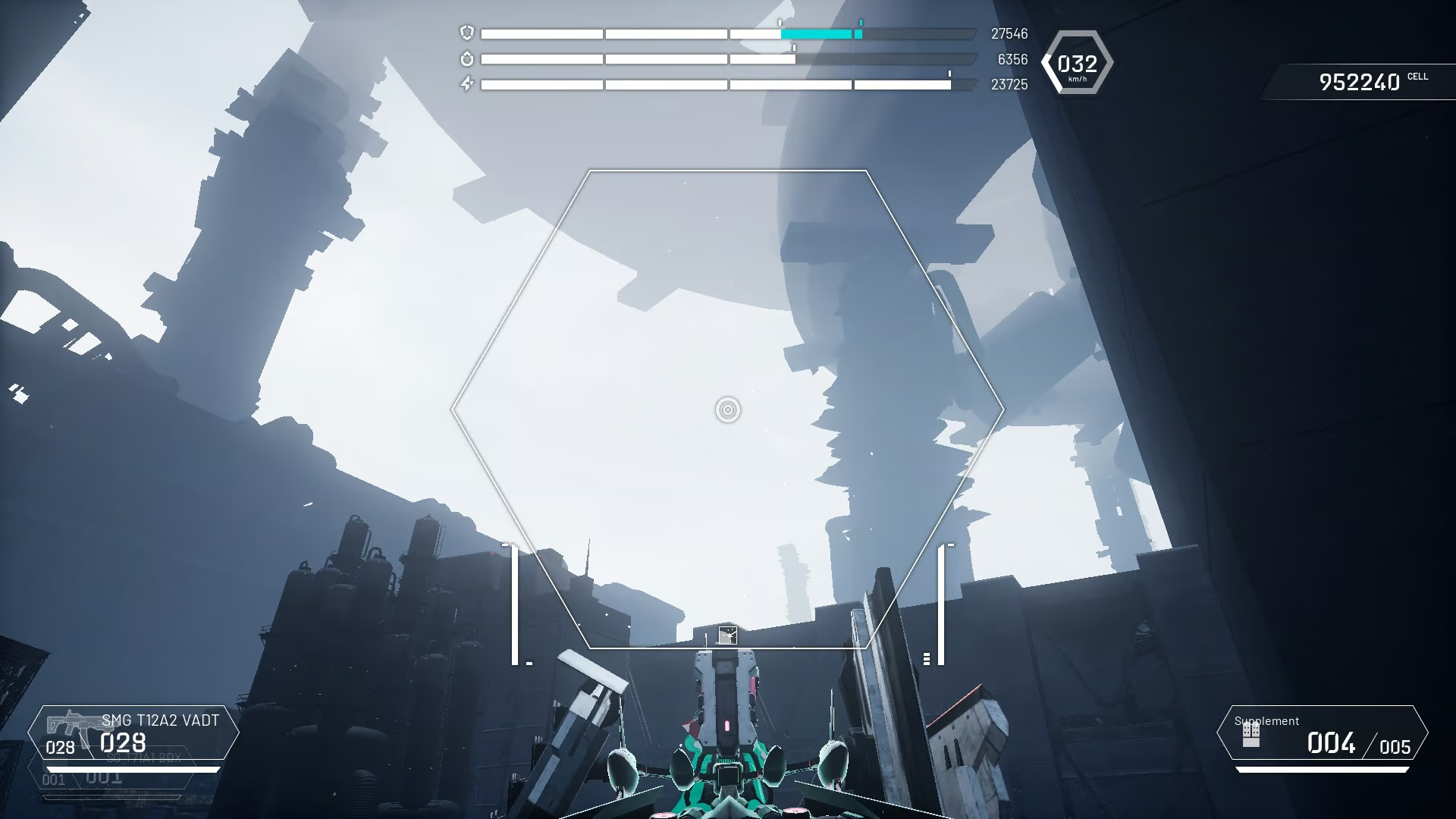
The aesthetic of this game is far stronger than the actual gameplay is. It's important to note that I've done two playthroughs; the first was with the vanilla game, and the second was with a few mods that massively rebalance the game, and I strongly believe that those mods are what made the game more playable the second time around. It's no surprise I made it significantly further on the second playthrough than the first.
The gameplay has three major areas: exploration, customisation, and killing. The customisation is quite in-depth; you can customise your little doll girl's colours, her clothes, and her hairstyle. Some of these you can buy from an NPC in the hub, whilst some are found from killing mobs or other NPCs. I didn't really interact with this part of the customisation system at all; I just made my nymph look like Kotone Fujita and was done with it. The other side of the customisation is building your own custom mech from parts you scavenge around the map.
There are a lot of parts, divided into categories and subcategories. The mobility units change how you... move, obviously; the hangar unit is for your health and your rear weapon production, the thruster mostly controls boosting and air-speed, the utility unit has a bunch of extra functions like a shield bubble or spreading chaff, and the headset module is used to buff certain aspects of the lock-on system. These are all freely mix-and-matched and you can build your own frame entirely up to your preferences. In my first playthrough, I built a long-range high-mobility frame and in my second frame I built a bulkier raw-speed frame with a very large targeting reticule.
The weapon variety is massive too, with nearly a hundred small arms and thirty rear weapons that can be mounted on the frame. There's the classical shooter weapons, like the submachine guns or sniper rifles, as well as the mecha classics like beam rifles and melee weapons, and also some unique ones like bubble cannons or wave guns. Again, this is all very mix-and-match; in my first playthrough I used the beam rifle and a sniper rifle, and in my second playthrough I alternated between dual-wield plasma pistols, and a submachine gun/box pistol combo. The rear weapons have less variety, with only four types: missiles, artillery, trebuchet, and sniper. I didn't use these on my first playthrough but on my second playthrough I ended up with a sniper rifle permanently mounted and switching between various missile launchers on the left.
There are, however, two fundamental problems with the gameplay and the customisation system. The first is that the gunplay is, frankly, not very good. Shooting feels very weightless because the mobs barely react to your shots. There's no knockback, no stunning, nothing. It doesn't really matter what weapon you use either, as they all have this issue. A string of submachine gun shots feels the same as a single shotgun blast, or a grenade launcher hit, or a whole bunch of missile hits. The game incentivises you to shoot enemies in their weak spot (which is nearly always at the back) but this doesn't meaningfully affect their behaviour; the only thing you get is a bit more damage and a different hitsound. Not that it really matters, because enemies turn on a fucking dime so getting to the back of 90% of them is an exercise in futility.
The second is that the balance is absolutely horrendous. Most weapons are genuinely unusable garbage and only a few are really viable; shotguns do next to no damage and require you getting WAY too close, pistols and light submachine guns are peashooters, the wave guns constantly get caught on terrain, and grenade launchers take far too much BP and have a pitiful reload time. What is BP? Well, it's your global ammo pool.
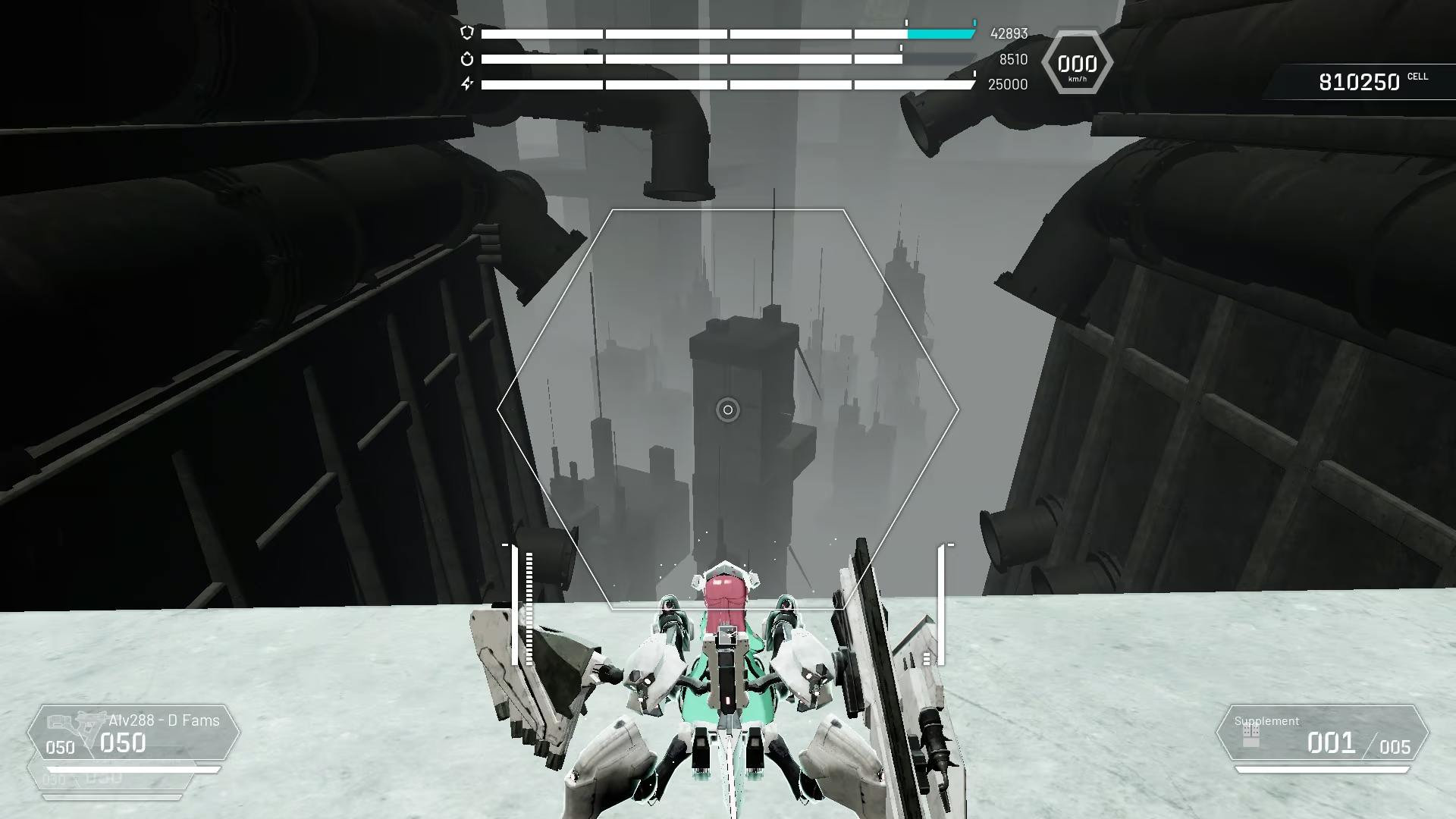
The BP mechanic is the worst mechanic in the game, and it kneecaps the entire design. You have three bars at the top of the UI: your "DP" is your health, your "EP" is your rechargeable energy store, and your "BP" is your global ammo pool. Every weapon—for small arms, on a reload, and for rear weapons, on firing—uses up some BP and it doesn't regenerate by itself. You start with 10k, you can upgrade it to about 13k maximum if you wish, and you can carry five "supplements" that give you 3000 BP back. This means that every single weapon has to be evaluated on exactly one metric: how much BP it uses for its damage output. This means that the beam rifles are nearly objectively the best small arms in the game purely because they use barely any BP for their damage output, and weapons like the shotgun are even worse because they eat up all of your BP alongside doing nothing to mobs too.
Rear weapons are punished even harder for this; aside from the sniper rifle, which nearly always one-hit kills weaker mobs, they universally have a horrible damage/BP cost ratio. I do genuinely get what the devs were going with for this system, because without it you can spam dual missiles and annihilate everything in your way, but the damage numbers are so low compared to the BP costs and the small arms using the same BP pool means that any time you whiff a mob with a missile or an artillery shot that's a full clip of your submachine gun wasted. It's not really much of a problem in the levels, as your supplements can keep your bar high and you can resupply at the start of the level very often, but for bosses it often comes down to quite literally "do I have enough ammo to kill it?" Keeping the BP system just for the rear weapons (and giving them a full balance pass) would fix probably the most major issue with the game, massive increase build viability, and overall just make it more fun.
There are ways other than consumables and respawning to refill your BP bar; if you land the final shot on a mob in its weak spot, it drops a blue orb that gives you back around 500 BP. This means you are heavily encouraged to dodge mob attacks and strike their weak spot instead. Like all the other problems with this game, this is very cool in theory but completely sucks in practice. Mobs have a way higher turning speed than you do, so outside of the really big ones it is usually impossible to get behind them unless they're in a cooldown (and even then, some dance around you anyway). It also doesn't matter if you hit the weak spot for 99.9% of their health bar; if the final shot was on their front, you don't get the orb, so if the mob ends cooldown and does a 180 turn to start shooting at you, that's a bunch of your time wasted.
It would be amiss not to mention melee weapons, which don't suffer from this problem at all. Instead of consuming BP, they consume your passively recharging EP bar instead, and also universally do massive damage making them objectively the best weapons in the game. They do have a very substantial cooldown period, but this is no different to the ten second long reload time of every other gun, so it's not a real downside. Packing a submachine gun and a melee weapon can easily trivialise the entire game.
It's not only weapons that suffer from this imbalance. Even with the balance patch, half of the utility modules are useless; the spotlight one is obviously always bad, the drone one locks on to random enemies through the walls and barely does any damage, and the plasma flares one seemed to just be a lag cannon. I don't think I've changed the hangar module even once, because the one I used maxes out on rear weapon shell production speed which is the only important stat for the sniper rifle and missile spam.
Most of these issues with the items are fixable without much effort, which is a shame because the loot system for getting the items is very well designed. Few items are actual up/downgrades, with nearly all drops instead just being an alternative; for example, there is a large variety of headset modules which each trade off one of either lock-on range, lock-on speed, or lock-on area. You can find modules that are really good at one, good at two, or sorta alright at all three and it entirely depends on your playstyle which one you want to use. It's (in theory) the same for the weapons; my preferred submachine gun does more damage but has a smaller clip and a longer reload time than some of the others. Another example is the plasma pistols I had equipped a lot of the time, which absolutely shredded anything that they hit but at the cost of a tiny six-ammo clip and a long reload time.
One of the best things about the loot system is the UI for equipping things. Whilst it's not perfect, I would've really liked to see an indicator for when something is new rather than having to remember each one, it is very informative about the upsides or downsides of every piece of equipment, showing you directly every single stat for equipment in comparison to the previous one as well as your total stats on the side. The stat names aren't always obvious, but pressing M and hovering over a stat name gives a longer description which every single game needs to have. Both frames and weapons can be upgraded in the hub area, and for weapons it gives obvious benefits: more damage, less reload speed, faster projectiles, and so on. Unfortunately, for frames the only benefit seems to be more health and better status effect resistance, with none of the inherent stats getting an improvement. Still, they have distinct upgrade items so you don't miss out on weapon upgrades if frame upgrades are invested in, which is a stark improvement over a lot of games.
Weapon and frame drops are found all over the place, in floating cubes that are dotted around the map. Sometimes these are obvious, sometimes they're out of the way and you have to find them. After beating a level's boss the game puts extra nymph minibosses in hidden areas around the level which always have unique drops, as well as a nerve sample drop which lets you directly upgrade your nymph girl. This is the exploration part of the game; does this side area have a new weapon drop that I can check? The answer is usually yes, although there are also a lot of cubes that have useless consumable items that mostly clog up the inventory, like grenades or throwing knives. These items would be more useful if you could carry more than five at a time, or if using them wasn't so damn slow, but they are basically always useless compared to the regular weapons.
Sadly, actually exploring the levels feels really quite bad due to how mediocre the actual movement aspects all feel. You can walk normally at a slow speed, you can zoom around Rick Dom style which uses up your energy bar, or you can dash which uses up more of your energy bar. You'll want to be permanently zooming around, because most enemies can't track you past around eighty mph, and I do understand that this is why it has to use up your rechargeable energy in the process. But when your base movement is so slow, it means to actually traverse the levels you zoom for thirty seconds, do a slow-ass walk for thirty seconds as the energy bar recharges, and repeat. I never found dashing to be useful except when I was using the wheels mobility frame—because those trade top speed for a total inability to brake—no matter what thrusters I was using. Despite that, the ground movement is still vastly superior to the air movement.
There's no way to put it nicely here: the air movement is fucking horrendous. To get in the air you jump, but there is a hundred millisecond delay between hitting the jump button and actually jumping. Let me be absolutely clear, too: this is a JUMP. You are not boosting upwards. You jump in the air at a fixed speed upward, then stop thrusting and gravity takes over, like in a fucking 3D platformer. When you're in the air, you can slow fall, but you can never ever gain height or even really maintain height. You also have some truly horrible air resistance so you float around at around 30mph, with the only way to go faster being your dash which is just as bad as it is on the ground.
But that's not the worst part. The worst part is that if you walk off a ledge—and you will, either from misjudging a height, using a mobility frame without sufficient braking power, or just somehow accidentally sliding off a slope—you drop like a fucking rock straight downwards. You will never make it back on the platform because you have no possible way to gain height. On some levels and on some upwards slopes you can float off and around the side to land back on the ledge, but if it's a flat surface? You die. The worst level for this is the Water Treatment Levels, where if you touch the water without something floating—that's it. You're dead. Add in the delay before you actually jump and I found myself just walking off of platforms like a fucking moron where my nymph just didn't jump in time and falling to my death.
It could be a lot worse because there is very little mandatory platforming. At worst, you have to fall down from a higher area, but unless you're going for every single cube you very rarely find yourself having to float around. The flying mobility frames are explicitly designed for air movement, and they do improve your air mobility a little bit, but you're still not going to be flying around like you're in a Source engine game. I spent most of my time zooming around on the floor, going really fast, and that was a mostly tolerable form of gameplay.
Thankfully most of these annoyances are simply annoyances and not dealbreakers because of the game's difficulty, or rather the lack of difficulty. There are definitely some mobs that will fuck you up if you're not careful, especially in the later levels, but if you go through the game systematically and carefully you are very unlikely to encounter significant resistance. Every mob follows roughly the same structure: first, it shoots at you. Then it starts a cooldown period where it stands still and doesn't shoot at you. Then it repeats. This means most encounters follow a simple loop of waiting for it to cool off before going behind it and annihilating it. If there's multiple enemies in an area you can still usually do this if you're fast, but it's often easier to just annihilate them all with concentrated fire instead.
The game also automatically aims for you. This was clearly intended to be played on a controller, and I would guess this is a mechanic shared with Armored Core games, but for mouse + keyboard it makes it a little bit too easy for most mobs. The auto-aim works by locking on to a target within the targeting reticule—and you have headsets that change both the size of the reticule and the time taken to lock on, which also varies by weapon—and once locked on, all of your attacks will be aimed directly towards the enemy even if you're not looking directly at them. It even has the decency to lead your attacks, too, which is very useful since there's no hitscan weapons in the game, but the tracking does fail for fast enemies combined with slow weapons and can often make you miss otherwise well aimed shots entirely.
Well, all enemies lead their attacks too; if you try to zoom in one specific direction the mobs will nearly always hit you. You have to juke them out by shifting left or right, and I think the intention was to use your dash for this but they usually lead their shots so hard that slowing down slightly is enough to dodge for anything that uses a slow-speed or slow firing weapon. But with the barrier system acting as a small extra regenerating health bar to tank some early hits, you can afford to be incredibly aggressive and get up in their faces regularly.
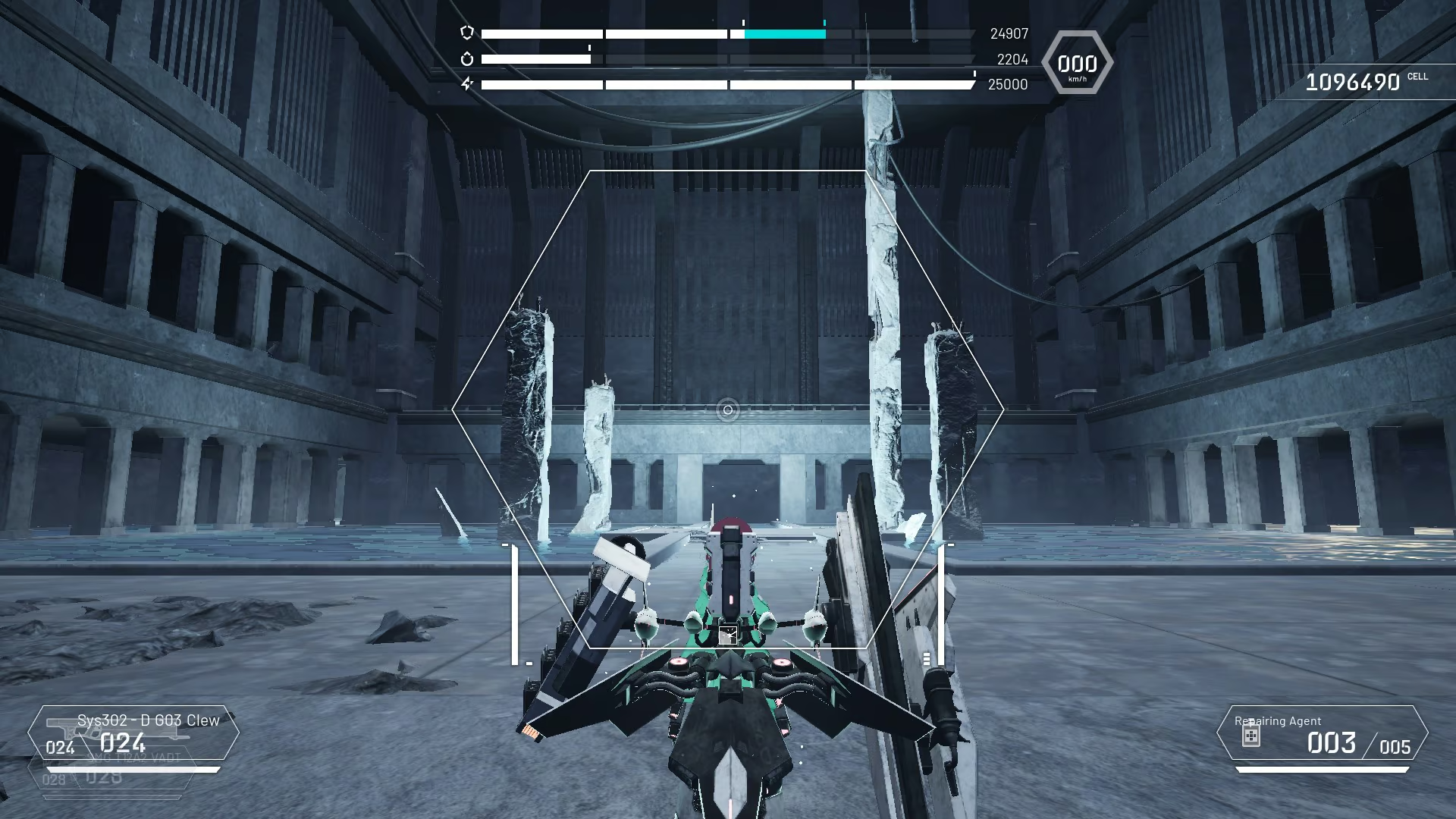
But the real issue with the difficulty is the bosses. I am generally on the side of wanting my games to be too easy, rather than too hard, but the bosses in this game are almost comically easy. They are slow, have extremely obvious wind-ups, the arenas are usually terrible, and they have fairly low health in general. There's no better example for this than the floating eyeball cannon boss. Design-wise, it's a heavily armoured floating boss that uses funnels to attack you, and then unfolds itself to shoot a super-laser occasionally in its second phase. This is a good idea in my opinion, but the boss is so pitifully easy for one big reason: there are FOUR massive indestructible pillars in the arena that you can hide behind without any repercussions! I just took potshots from behind a pillar and defeated it within no time at all; so much for all that armour.
This is a common theme with a lot of the bosses. The policing unit has a basic charge and basic explosion attack, both of which can be trivially dodged whilst you dump ten submachine gun clips into it. The forest tank boss is a joke; it has armour-plated weak spots that you can shoot at from specific angles anyway, without needing to break them as is intended and it can't hit you at all if you shoot the missile as it launches. I don't even know what the gimmick of the stealth tank boss was, I killed it too quickly. The only one of these "mechanical" bosses I liked was the Colony Depot, which is a basic swarm boss—but you can defeat it by just... zooming around in circles. It does function as an effective calmness check, in that if you panic you die but if you just keep moving the colony can't hurt you.
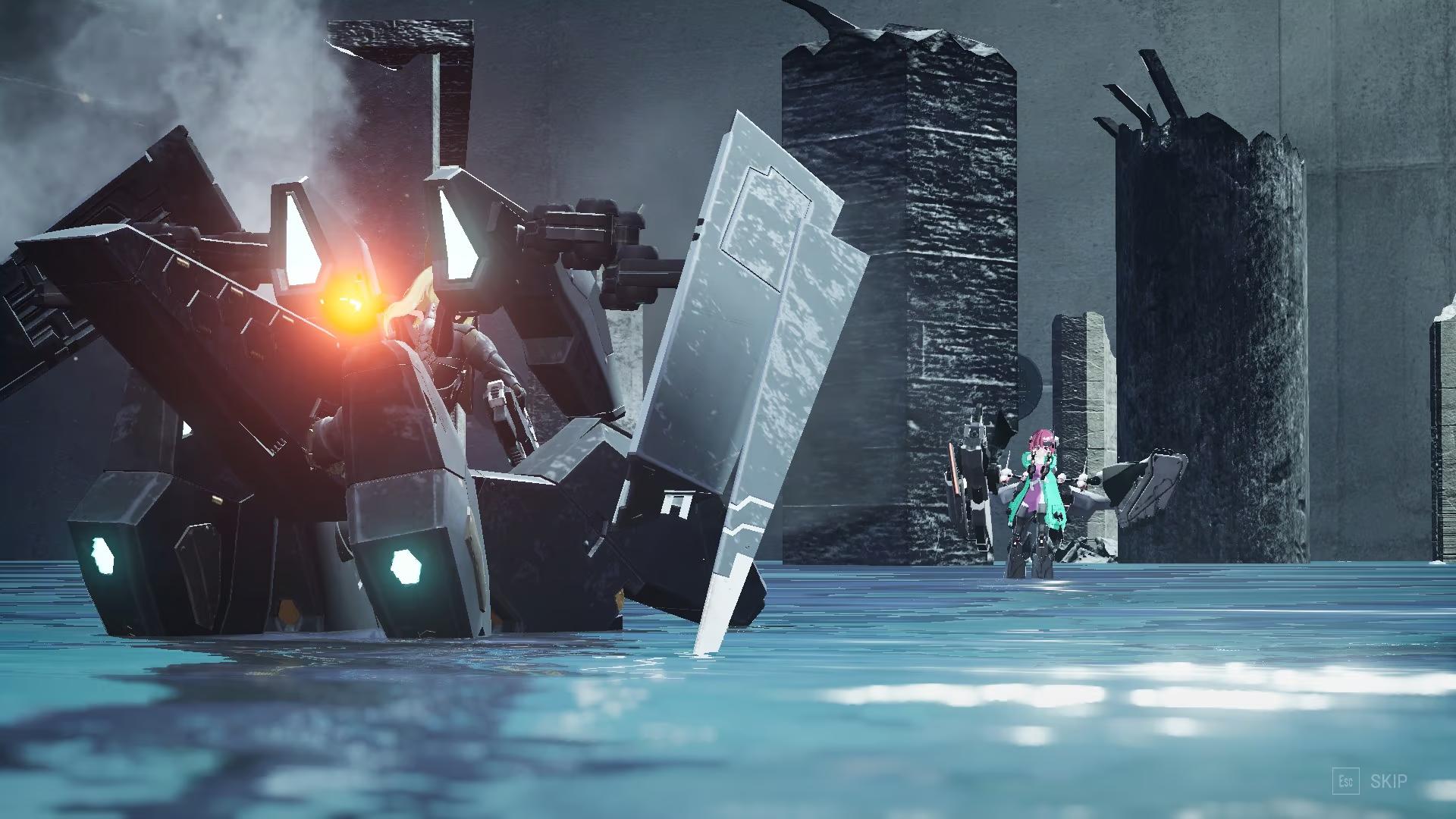
After the actually designed bosses the game starts throwing other nymphs at you as other bosses and these are definitely harder but still nothing too hard. You do have to think about how to defeat them a little bit; Leki in the poison swamp is invulnerable half of the time, the Royal Guard is mostly a pushover (except for the lag laser) but she WILL kill you if you get distracted by the summon, and the Unidentified Frame Unit caught me by surprise and actually scored a kill on me until I changed my frame loadout. But they're not too hard, just a bit different, especially when their tracking can't keep up with you if you're going too fast. Hell, the hardest part is actually hitting the nymph bosses because of how fast they go.
It's important to note that the game does have a challenge mode, which I tried for a bit but got hard filtered by, so I can't really speak on it much further. I think there is a good midpoint available between the joke bosses of the base game and the "made for steam forum users" challenge mode that's possible to implement.
There's one notable omission from my review thus far: the story of this game. That's because this game doesn't really have a story, in a traditional sense. You talk to the impaled queen in the hub area who asks you to find all of her body parts, and that's about it. You can get some background lore in the form of twenty questions by talking to her, but there's not really much actual storytelling involved. You're a "nymph" (and so is every other doll girl you see), spawned from a queen, and you live in a crater. Every frame and weapon has a small lore tidbit attached to it as well, giving small parts of exposition about the world and its factions. I like this a lot; it really does fit the game's aesthetic very well. The lore is quite detailed, too.
There are actually several NPCs around the world that you can either talk to or just kill, and they have their own small quests that net some rewards. They're usually in very obscure places, such as the main vendor NPC Yoyo who is found by backing up on the pipe in the Central Cavern and walking on a set of catwalks into a side area. She is completely optional and missable, and if you don't find her you'll have to go the whole game without being able to buy supplements, repair packs, or more importantly the upgrade items. The rest aren't quite so essential, but they do give some good items at the end of their quests and there's a lot of narrative purpose built in to them, at least for the ones that didn't release unfinished.
I think "unfinished" is the best word to describe Dolls Nest. That's not because it actually launched unfinished, it is absolutely a complete and playable game, but because so much of the game is only halfway to being good. The game is absolutely fixable with relatively few changes: remove the BP system from small arms, remove the fucking invisible spider spawners from one of the first levels, make particle effects less laggy, and let me stun enemies or otherwise make the shooting a bit more impactful. Alongside a full balance pass, this would make the game far more enjoyable to play than it is, even if a lot of the foundations are still kinda gooey.
The good news is that Nitroplus seem to have some faith in the game, launching a spinoff manga (Dolls Nest: OPRHANS) that retells the story in more detail and is written by the main writer of the game. It also seemed to sell fairly well, with ~2200 positive reviews (at the time of writing), and there's a lot of places to go for a potential sequel; after all, this game only covers a tiny amount of the total available world of Hod. Can I recommend this game? Despite everything, yeah, I can. It's still a 6/10 game, but with the balance mod it's an enjoyable game to play through. If there is a sequel, and it improves on the areas I've complained about here, I am certain that it will be an incredible game. It's just a shame that Dolls Nest had to exist in this state for any such sequel to improve on it.